


official tune
As you can see, « per sas culpas », or Cantiga de Santa María number 166, is one of more than 400 songs that were written at the court of King Alfonso X “The Wise”, King of Castilla, from 1252 to 1284.
At that time, Galician was one of the cultured languages spoken in the country in court and high circles. A language that the King learned as a child in the lands of Allariz and Maceda (Ourense), where he spent a good part of his childhood.
As the Occitan, Italian and Catalan troubadours had done before him, the monarch used Galician as a language of prestige and international communication.
The Cantigas de Santa María, written in honour of the Virgin Mary, narrate the miracles worked by her divine intervention. They are presented in a way that could be called multimedia, as they are composed for a poem, a musical piece and a painted image of each one of them. Such is their beauty that they have been referred to as the aesthetic Bible of the 13th century by the Honourable Mr. Marcelino Menéndez Pidal.
Basically, a 12th century work written in Galician, with a clear universal character that gives prestige to our language all over the world.
Due to its transversality, it is also widely versioned in its different forms, but mainly from the musical one, being in the repertoires of a wide variety of stylistically very different groups. It is even part of the original soundtrack of a major film blockbuster, Conan the Barbarian, where precisely C.S.M. 166 or “Como poden per sas culpas” is played at a prominent moment in the film.
Therefore, we wanted to continue making history, thanks to the history already made and in 2002, where we recorded with Luar Na Lubre this song from the inmost respect.
We made an adaptation to our instrumentation and with our arrangements and the sensational collaboration of the Bratislava Symphony Orchestra. For us the result was dreamy and this song was in our repertoire for years.
With the passing of time and the renewals of each season, the song was gradually taken out of the repertoire, but nevertheless, it always remained a very important piece of our work.
In 2022 we received a call from Ezequiel Mosquera, expressing the intention of using it as the soundtrack for the Tour of Galicia. A great honour that we were delighted to accept.
I am sure that King Alfonso X the Wise, as well as his entire court of collaborators, could not have imagined everything that would happen in posterity with their work, but it is undeniable that they left a great legacy that is constantly and permanently recognised from very different fields.
In this case, that of Galician cycling.
In O Gran Camiño, we carry in our DNA a deep pride for Galicia: for its landscapes, its sport, its people, its heritage, and its culture. We want all of this to be known throughout the world.
That is why we chose for our official anthem a composition that, eight centuries ago, already reflected the presence of our own language—our hallmark of identity—as a cultural reference beyond our borders.
O Gran Camiño moves to the sound of “Como podem per sas culpas”, number 166 of the Cantigas de Santa María, written in the 13th century in Galician by the only king who dared to call himself “the Wise.”
Thanks to the version recorded in 2002 by Luar na Lubre with the Bratislava Symphony Orchestra, and with the arrangements incorporated for the 2026 edition by producer Iago Pico, the pedal strokes of O Gran Camiño also carry the musical imprint of Galicia’s history around the world.
In the 13th century, when Alfonso X the Wise wrote—together with other troubadours—the more than 400 poems that make up the Cantigas de Santa María, Galician was the language of cultural reference across the Iberian Peninsula, represented as a whole by the extensive Galician-Portuguese lyric tradition.
The Castilian king spent part of his childhood at the Castle of Maceda, in Allariz (Ourense), where he likely learned the Galician language that he would later use for this highly significant poetic corpus combining text, music, and imagery. A legacy of Galician culture that today we are proud to continue honoring and promoting.
su cultura. Todo eso queremos que se conozca en todo el mundo.
Por eso, elegimos para nuestra sintonía oficial una composición que ya hace ocho siglos daba cuenta de la presencia de nuestro idioma propio, nuestra seña de identidad, como referente de cultura más allá de nuestras fronteras.
O Gran Camiño transita al son de ‘Como podem per sas culpas’, la numero 166 de las Cantigas de Santa María que en el siglo XIII escribió, empleando el gallego, el único rey que osó llamarse Sabio.
Gracias a la versión grabada en 2002 por Luar na Lubre con la Orquesta Sinfónica de Bratislava, y con los arreglos que en la edición 2026 le ha incorporado el productor Iago Pico, las pedaladas de O Gran Camiño llevan también el sello musical de la historia de Galicia por todo el mundo.
En el Siglo XIII, cuando Alfonso X El Sabio escribió, junto con otros trovadores, los más de 400 poemas que conforman las Cantigas de Santa María, el gallego era el idioma de referencia para la cultura en la península, representada en su conjunto por la extensa lírica galaico-portuguesa.
El rey castellano había pasado parte de su infancia en el Castillo de Maceda, en Allariz (Ourense), donde probablemente aprendió el idioma gallego que, después, emplearía para este importantísimo corpus poético que combina escritos, música e imagen. Una huella de la cultura gallega que hoy queremos seguir poniendo en valor.
luar na luBre
As you can see, « per sas culpas », or Cantiga de Santa María number 166, is one of more than 400 songs that were written at the court of King Alfonso X “The Wise”, King of Castilla, from 1252 to 1284.
At that time, Galician was one of the cultured languages spoken in the country in court and high circles. A language that the King learned as a child in the lands of Allariz and Maceda (Ourense), where he spent a good part of his childhood.
As the Occitan, Italian and Catalan troubadours had done before him, the monarch used Galician as a language of prestige and international communication.
The Cantigas de Santa María, written in honour of the Virgin Mary, narrate the miracles worked by her divine intervention. They are presented in a way that could be called multimedia, as they are composed for a poem, a musical piece and a painted image of each one of them. Such is their beauty that they have been referred to as the aesthetic Bible of the 13th century by the Honourable Mr. Marcelino Menéndez Pidal.
Basically, a 12th century work written in Galician, with a clear universal character that gives prestige to our language all over the world.
Due to its transversality, it is also widely versioned in its different forms, but mainly from the musical one, being in the repertoires of a wide variety of stylistically very different groups. It is even part of the original soundtrack of a major film blockbuster, Conan the Barbarian, where precisely C.S.M. 166 or “Como poden per sas culpas” is played at a prominent moment in the film.
Therefore, we wanted to continue making history, thanks to the history already made and in 2002, where we recorded with Luar Na Lubre this song from the inmost respect.
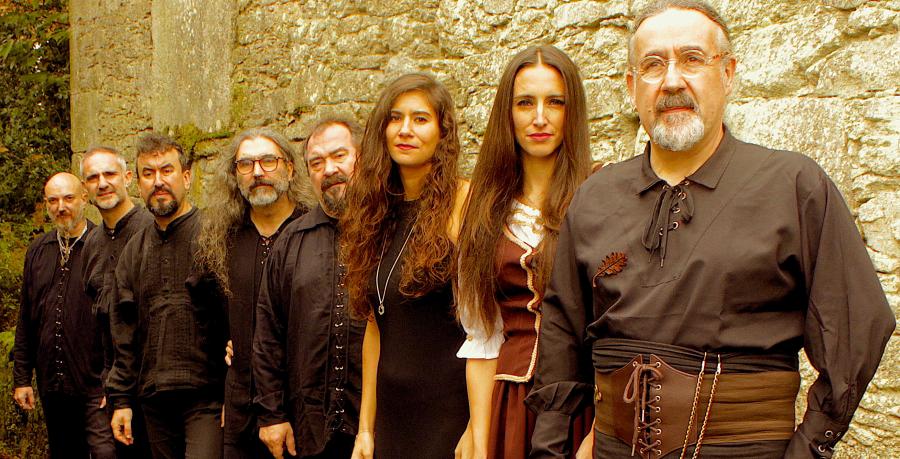
We made an adaptation to our instrumentation and with our arrangements and the sensational collaboration of the Bratislava Symphony Orchestra. For us the result was dreamy and this song was in our repertoire for years.
With the passing of time and the renewals of each season, the song was gradually taken out of the repertoire, but nevertheless, it always remained a very important piece of our work.
In 2022 we received a call from Ezequiel Mosquera, expressing the intention of using it as the soundtrack for the Tour of Galicia. A great honour that we were delighted to accept.
I am sure that King Alfonso X the Wise, as well as his entire court of collaborators, could not have imagined everything that would happen in posterity with their work, but it is undeniable that they left a great legacy that is constantly and permanently recognised from very different fields.
In this case, that of Galician cycling.
luar na luBre